
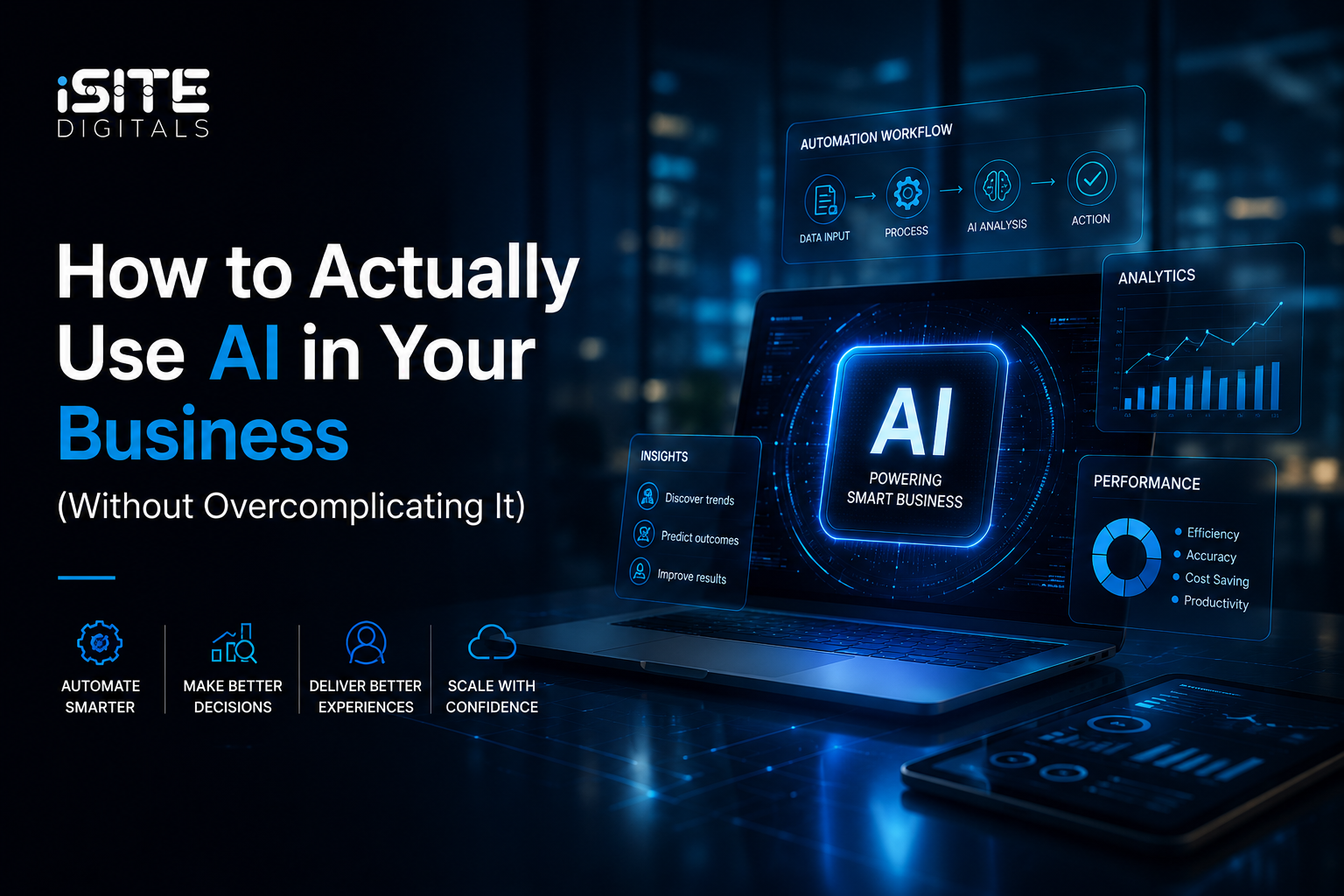
Artificial Intelligence is everywhere right now.
Every day, businesses hear about automation, AI assistants, predictive analytics, AI-generated content, and machine learning tools promising massive transformation.
But for many organizations, the real question is still simple:
“How do we actually use AI in a practical way?”
The challenge is rarely access to AI tools anymore. There are countless platforms available. The real challenge is understanding where AI genuinely creates value and how to implement it without adding unnecessary complexity.
At iSite Digitals, we believe the most effective AI strategies are usually the simplest ones.
The Problem With Overcomplicating AI
One of the biggest mistakes businesses make is trying to transform everything at once.
Many organizations approach AI by:
- Trying to automate every process immediately
- Purchasing expensive platforms without clear goals
- Expecting instant results
- Implementing AI without proper workflows or infrastructure
- Focusing on trends instead of business problems
This often creates confusion instead of efficiency.
Teams become overwhelmed.
Processes become fragmented.
Costs increase without measurable results.
AI is not valuable simply because it exists.
It becomes valuable when it solves a real operational problem.
Where AI Actually Delivers Value
The businesses seeing the best results from AI are not always the ones using the most advanced systems.
They are the ones applying AI intentionally.
Some of the most practical use cases include:
Automating Repetitive Tasks
Many businesses still spend hours on repetitive manual work:
- sorting emails
- updating records
- generating reports
- routing support requests
- scheduling workflows
AI can automate these repetitive processes and free teams to focus on higher-value work.
Improving Decision Making
AI tools can analyze large amounts of operational or customer data much faster than manual processes.
This helps businesses:
- identify trends earlier
- reduce human error
- improve forecasting
- make faster decisions
- optimize resource allocation
The goal is not replacing people.
It is helping teams make smarter decisions with better visibility.
Enhancing Customer Experience
AI can improve customer interactions through:
- intelligent support systems
- faster response times
- automated ticket routing
- personalized recommendations
- improved communication workflows
When implemented properly, AI helps businesses become more responsive and efficient without losing the human side of customer service.
Supporting Operational Efficiency
AI works especially well when combined with strong infrastructure and organized workflows.
Without reliable systems, AI often creates more noise instead of meaningful improvement.
That is why successful AI adoption depends heavily on:
- organized processes
- clean data
- scalable infrastructure
- reliable cloud environments
- secure systems
AI is most effective when the foundation behind it is already stable.
Start Small Before Scaling
One of the most effective ways to introduce AI into a business is to start with a single, measurable problem.
Instead of trying to “become an AI company,” focus on improving one operational challenge.
A practical approach usually looks like this:
1. Identify One Problem
Find an area causing inefficiency, delays, or repetitive work.
2. Apply a Simple AI Solution
Choose a tool or workflow that directly addresses that issue.
3. Measure the Results
Track improvements in:
- time saved
- response speed
- operational efficiency
- customer experience
- productivity
4. Expand Gradually
Once one system works successfully, scale carefully into other areas of the business.
This approach minimizes risk while creating measurable results.
AI Should Support Your Business, Not Complicate It
There is a common misconception that AI implementation must be highly technical or disruptive.
In reality, the best AI solutions often feel invisible.
They quietly improve workflows.
They reduce operational friction.
They help teams work faster and smarter.
They support growth without creating unnecessary complexity.
Businesses do not need complicated AI strategies.
They need practical systems that solve real problems.
Final Thoughts
AI does not need to be overwhelming to be effective.
When approached strategically, AI becomes a practical business tool rather than a complicated trend.
The companies benefiting most from AI today are not necessarily the ones chasing every new tool.
They are the ones building reliable systems, improving workflows, and applying AI where it creates real operational value.
At iSite Digitals, we help businesses implement practical technology solutions that improve efficiency, scalability, and long-term growth without unnecessary complexity.